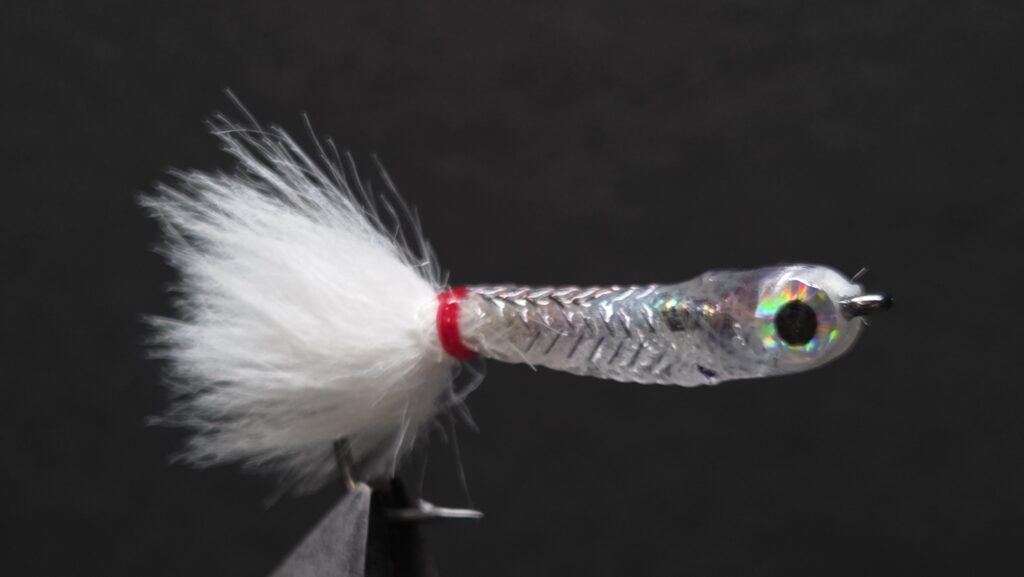
What Fish Actually See
Fish Usually React Before They Analyze
- Predatory fish are built to detect:
- movement
- silhouette
- contrast
- flash
- Fish often strike from instinct and reaction.
- In moving water especially, fish may only get a brief look.
Important Points:
A fish may recognize:
- prey profile
- vulnerability
- fleeing movement
“Movement usually gets noticed before detail gets inspected”
Long before it notices tiny details.
Why Many Old-School Streamers Never Had Eyes
Simplicity Has Been Catching Fish for Decades
- Lefty’s Deceiver
- Woolly Bugger
- Muddler-style streamers
- Bucktail streamers
Points:
- Many legendary flies succeeded without eyes.
- Guide flies are often tied quickly and simply.
- Durability and speed matter to guides.
- Guides care more about catching fish consistently than tying pretty flies.
“Fish don’t grade flies like judges at a fly-tying show.”
The Argument FOR Eyes
There ARE Legitimate Reasons to Use Eyes
A — Realism Points:
- Eyes may help complete the illusion.
- Clear water fish sometimes inspect flies longer.
- Saltwater species may react differently than river smallmouth.
“There are situations where realism probably matters more.”
B — Strike Target Theory Points:
- Predators often attack the head.
- Contrast spots near the head may guide strikes.
- An eye may create a focal point.
C — Weight and Action
Explain:
- Dumbbell eyes
- Bead chain eyes
- Lead eyes
These do more than imitate eyes.
They affect:
- sink rate
- posture
- jigging action
- hook orientation
“Sometimes the ‘eye’ is really a weighting system disguised as anatomy.”
The Argument AGAINST Eyes
Are Eyes Sometimes More About Anglers Than Fish? Points:
- Eyes often fall off anyway.
- Fish still eat the fly afterward.
- Added expense
- Extra tying time
- Extra failure points
Strong Observation:
Humans naturally associate eyes with life.
Fish may not care nearly as much as we do.
“A fly only has to fool the fish… not win a realism contest.”
Water Conditions Change Everything
Situations Where Eyes MAY Matter More
- Clear water
- Slow retrieves
- Suspended fish
- Saltwater flats
- Highly pressured fish
Situations Where Eyes Probably Matter Less
- Stained water
- Aggressive fish
- Fast strips
- Current-heavy rivers
- Reaction strikes
- Smallmouth ambush feeding
“A smallmouth crushing a streamer in stained current
usually isn’t conducting a detailed eye exam.”
My Personal Take
- Eyes can help in certain situations.
- But they are rarely the PRIMARY reason a streamer succeeds.
- Size, shape, movement, and presentation matter far more.
- Confidence matters too.
Practical Experimentation Fish the Same Fly Three Ways
- Large eyes
- Small eyes
- No eyes
Same:
- color
- size
- action
- retrieve
Observations:
- Which gets follows?
- Which gets commits?
- Which hooks fish better?
Frugal Fly Rodder Philosophy:
“The creek usually tells the truth faster than the internet.”
CONCLUSION
Final Thought Direction:
- Fly fishing trends change constantly.
- Fish behavior changes far slower.
- Don’t let marketing override common sense and experience.
- Eyes are a tool — not magic.
“In the end, fish usually care more about whether your fly looks vulnerable more than whether it has eyeballs.”
Leave a Reply
You must be logged in to post a comment.